
An Update on Two Holdings with Potential to Benefit from AI
In this letter we share some thoughts from the Portfolio Managers at Broad Run Investment Management, LLC, the Fund’s sub-advisor.
-
 David Rainey, CFACo-Portfolio Manager
 -
 Brian Macauley, CFACo-Portfolio Manager
 -
 Ira Rothberg, CFACo-Portfolio Manager
June 2026
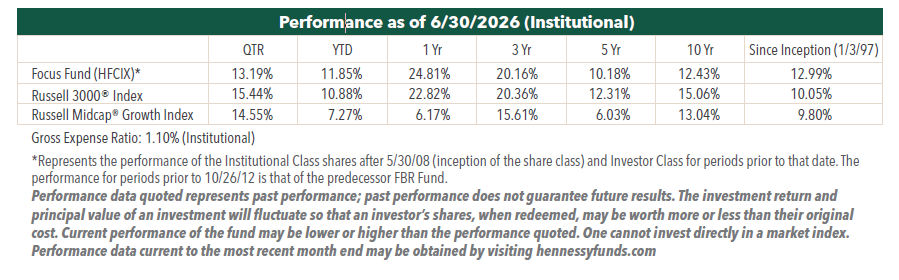
Performance data quoted represents past performance; past performance does not guarantee future results. The investment return and principal value of an investment will fluctuate so that an investor’s shares, when redeemed, may be worth more or less than their original cost. Current performance of the fund may be lower or higher than the performance quoted. Performance data current to the most recent month end, and standardized performance can be obtained by viewing the fact sheet or by clicking here. Neither forward earnings nor earnings growth is a measure of a fund’s future performance.
Lately, the most frequent question we are asked is: “how are you positioned for the AI boom?”
It is our belief that AI, and the related AI infrastructure buildout, is going to be long-lasting and transformational for our economy. We expect significant value will accrue to the companies selling “picks and shovels” for this buildout. Brookfield has projected $7 trillion of investment in such physical infrastructure over the next decade, underscoring the magnitude of the opportunity for those providing chips, hardware, data centers, and the power required to operate them.
We are direct beneficiaries of this spending through our investments in Brookfield Corporation, Brookfield Asset Management, Applied Materials, and Sunbelt Rentals. AST should eventually be a beneficiary as well, providing essential infrastructure for AI edge applications. At the same time, we have steered clear of undifferentiated businesses riding the AI boom (electrical and mechanical contractors, commodity data centers, cabling and server rack providers, etc.) and business models vulnerable to AI disruption (software, outsourcing, call centers, etc.).
Overall, we would describe our portfolio as a barbell: one portion a collection of competitively advantaged businesses we believe are positioned to benefit from the multi-year secular tailwinds of the global AI infrastructure buildout, and another portion a collection of AI-insulated, competitively advantaged businesses with strong growth opportunities independent of the AI theme.
In this letter we provide updates on our positions in Applied Materials and AST Space Mobile.
Applied Materials – Update
Nearly five years ago, we initiated a position in Applied Materials (AMAT) based on a compelling long-term outlook for wafer fab equirement (WFE) spending and the resilient, oligopolistic structure of the semiconductor capital equipment (semicap) industry. Our original investment case focused on the consolidated market, which features just five major players, exceptionally high barriers to entry, steep customer switching costs, and rational competition. Because each participant commands specific technological strongholds, the industry enjoys relatively stable market shares and highly attractive economics.
Within this oligopoly, AMAT stood out for its broad product portfolio and its Integrated Materials Solution (IMS) strategy. By bundling multiple manufacturing steps within a single vacuum system, IMS minimizes defects and accelerates time-to-market for customers. Alongside this technological moat, which is critical at the leading edge of chip manufacturing, we highlighted AMAT’s growth in high-margin recurring revenue service contracts helping to dampen volatility in a traditionally cyclical industry. At the time, we expected a steady 7% broader semiconductor industry growth rate to drive 8% to 9% organic revenue growth for AMAT, low double digit operating profit growth, and mid-teens long-term EPS compounding.
So far, results have been much better than our initial underwriting. Driven by the explosive adoption of generative and agentic AI, the semiconductor industry is on track to cross $1 trillion in revenue this year—well ahead of the original 2030 forecasts. AI technology has fundamentally transformed global compute demand, breaking a decades-long link where silicon growth was tethered to the human census of one person, one phone, one car. Even as the Internet of Things multiplied devices and chip density rose, growth still scaled relative to human activity. That linear relationship is over.
Chip production has decoupled from the human population, entering an era of multi-tiered compute where a single individual commands a vast, invisible constellation of silicon, and autonomous AI agents deploy networks of sub-agents of their own.
As a result of this paradigm shift, WFE spending growth has dramatically accelerated. Since our initial investment in 2021, when total WFE spend was in the roughly $90 billion range, industry spending has broken above the historical long-term trend line to an estimated $145 billion in 2026. This acceleration is expected to continue, pushing spending to near $200 billion in 2027 and upwards of $235 billion by 2028. We expect leading-edge foundry-logic, dynamic random access memory (DRAM), and advanced packaging to drive more than 80% of the year-over-year growth in 2026 and 2027. These are exactly the areas where AMAT holds market leading positions, particularly in materials engineering for gate-all-around transistors, backside power delivery, and high-bandwidth memory packaging.
AMAT’s outlook for the next two years is exceptional: management expects its semiconductor systems business to grow by more than 30% in calendar 2026, while characterizing 2027 as another record setting year for the industry. Furthermore, their Applied Global Services (AGS) segment is targeting a sustained mid-teens growth rate, fueled by rising fab utilization and the deployment of AI-driven predictive maintenance tools across their massive installed base. This positive outlook is supported by unprecedented demand visibility, with top customers now sharing eight-quarter forecasts, and some customers providing three-year projections and directional investment plans through 2030. Fearing equipment shortages, major buyers of semicap equipment are increasingly looking to lock in three- to five-year purchasing agreements.
In the intermediate term, we believe the semiconductor market will see sustained growth driven by a shift from model training to autonomous, task-executing “agentic AI.” Because agentic models require continuous reasoning, they demand central processing unit (CPU)-intensive architectures and drive huge demand for DRAM and NOT-AND (NAND) wafer fab equipment. We believe Applied Materials is well positioned to capture this memory expansion. As the current memory equipment leader, AMAT expects to gain market share during upcoming transitions to 4F2, and 3D DRAM architectures.
Longer term, AMAT’s end markets will broaden through physical AI, robotics, and orbital data centers. As physical AI and robotics advance, integrating digital intelligence with mechanical action will require specialized chips capable of continuous real-time processing and sensing. This shift, along with operating compute clusters in space, will accelerate demand for leading edge compute and radiation-tolerant mature nodes—directly feeding AMAT’s ICAPS (IoT, Communications, Auto, Power, and Sensors) business.
While Applied Materials no longer trades at the 16× forward earnings multiple we paid in 2021, we believe the current, meaningfully higher multiple is fully merited by the outsized earnings growth imbedded in the backlog over the next two years, combined with a now higher rate of secular growth beyond. We continue to view the company as a premier secular compounder well positioned to capture value from the unfolding AI revolution.
AST SpaceMobile – Update
“Never interrupt your enemy when he is making a mistake”
- Napoleon Bonaparte
Leading up to their June 2026 IPO and in more recent communications, SpaceX management has begun to suggest that Starlink Mobile has ambition to become a global competitor to the traditional wireless industry. This is a radical departure from its early efforts working with T-Mobile and other carriers, and is a strategic windfall for AST SpaceMobile.
Starlink is revealing itself to be a wolf in sheep’s clothing: appearing friendly at first, yet concealing a voracious appetite to compete. The company has spoken about bypassing wireless carriers to sell service direct to consumers, has acquired wireless spectrum (and is likely to pursue more), and is reportedly developing its own AI device in competition with Apple, Google, Samsung and others.
Importantly, while Starlink controls mid-band spectrum, it does not have low-band spectrum or a terrestrial radio network. These limitations will make it impossible to deliver quality of service anywhere near the levels consumers in developed countries have come to expect. Starlink is reported to be exploring ways to resolve these deficiencies, but there is a substantial gap to close and it is unclear how successful they will be. So, there is some potential that Starlink’s recent communications are mere posturing to drive better partnership deals with mobile network operators (MNOs), but the entire ecosystem is on alert and increasingly embracing AST as its white knight.
In May 2026, the U.S. MNO’s competitive response to Starlink became clear with the announcement of an agreement in principle to form a joint venture (JV) between AT&T, T-Mobile and Verizon for satellite services. With the new agreement in principle, the Big Three are now working together to close coverage gaps, pool limited spectrum and create a unified platform for satellite operators to deliver direct-to-direct (D2D). AST already had AT&T and Verizon as partners, so this should open the door for a potential AST/T-Mobile partnership too. This also appears to be a step toward T-Mobile’s exiting its exclusive business relationship with Starlink. Importantly, all three MNOs have made public comments about avoiding wholesale network agreements with Starlink, frustrating its U.S. ambitions.
Starlink poses a challenge not just for MNOs, but also for foreign governments. These entities are increasingly concerned with data sovereignty and control. They are seeking ways to safeguard their citizens’ data and maintain their own law enforcement and intelligence access to communications. Starlink Mobile’s architecture does not provide the control these countries outside the U.S. are looking for, while AST’s technology and MNO partnership model does.
To address these sovereignty concerns, in 2025 we saw a JV formed between AST and Vodafone, called Satellite Connect Europe. This partnership includes MNOs in 21 EU nations, with headquarters in Luxembourg, operations in Germany, and a development center in Spain. Satellite Connect Europe continued to gain form and function in the first half of 2026, and its structure will likely be a model for similar arrangements in other countries/ regions going forward.
In June 2026, a second foreign JV was announced between AST and Rakuten to develop and operate a low earth orbit (LEO) satellite network for D2D broadband service in Japan. This agreement is central to Japan’s J-LEO project, a government-backed initiative aimed at creating a sovereign, domestically owned and operated D2D satellite network. The Japanese government is committing about $1 billion of funding in support of this effort. Although structured to serve MNOs in Japan, in time we believe both the European Union (EU) and Japanese JVs may include government/defense applications as well. We would expect to see more foreign JVs in the future.
Not everything in the quarter was a positive development. AST was scheduled to begin near continuous service by year end 2026 with a fleet of approximately 45 orbiting satellites. This timeline was pushed back with two significant mishaps at Blue Origin, an important AST launch partner. First, in April, because of a thrust malfunction, Blue Origin failed to place AST’s BlueBird 7 into its intended orbit. Though the satellite powered-on, it was placed too low and was intentionally deorbited. The second setback occurred in May, when a Blue Origin New Glenn rocket exploded during a static fire test at Cape Canaveral. This caused extensive damage to its only working launchpad and surrounding structures. The investigation and repair work is ongoing, but Blue Origin launch is grounded, and the net result for AST will be a 6-to-9-month delay to achieving near continuous coverage with 45 satellites.
This slowdown in launch cadence is disappointing, but not catastrophic. This is opportunity delayed, not foregone. The company is well funded with one of the strongest balance sheets in the space industry. And progress continues. In mid-June, the company successfully launched a set of three second-generation Block 2 BlueBird satellites on a SpaceX rocket. They are now orbiting and are reportedly operating as expected. Looking out to 2028, we expect AST to have two to three distinct constellations in space, supporting low- and mid-band spectrum operations, sizable commercial and first responder revenue, and a growing defense and intelligence business.
Conclusion
We thank you for entrusting your capital to us. We will continue to do our best to protect and grow your investment over time.
Sincerely,
Broad Run Investment Management, LLC
Click here for a full listing of Holdings.
Click here for full, standardized Fund performance.
- In this article:
- Domestic Equity
- Focus Fund
You might also like
-
 Investment Idea
The Big Potential of Smaller Companies
 Neil J. HennessyChief Market Strategist and Portfolio Manager
 Ryan C. Kelley, CFAChief Investment Officer and Portfolio Manager
 L. Joshua Wein, CAIAPortfolio ManagerRead the Investment Idea
For much of the past decade, large-cap stocks have dominated market returns and investor attention. As a result, we believe many equity portfolios may now be heavily dependent on the continued performance of the market’s largest companies, potentially overlooking attractive opportunities elsewhere in the market.
-
 Fund Commentary
Cornerstone Growth FundA Fund Focused on Valuation, Growth and Momentum
Ryan C. Kelley, CFAChief Investment Officer and Portfolio Manager
L. Joshua Wein, CAIAPortfolio ManagerRead the CommentaryIn the following commentary, the Portfolio Managers of the Hennessy Cornerstone Growth Fund discuss the Fund’s formula-based investment strategy and how it drives the Fund’s sector and industry positioning.
-
 Fund Commentary
Focus FundHigh Conviction on Companies’ Long-term Future Earnings Power
David Rainey, CFACo-Portfolio Manager
Ira Rothberg, CFACo-Portfolio Manager
Brian Macauley, CFACo-Portfolio ManagerRead the CommentaryThe Portfolio Managers review the second quarter market and the influence of elevated inflation, rate hikes, the development of AI, and what gives them confidence in the portfolio’s ability to continue compounding earnings.
