
Attractive Valuations, Solid Fundamentals in the Financials Sector
Portfolio Managers Dave Ellison and Ryan Kelley discuss performance, interest rates, loan demand, credit conditions, valuations, and opportunities in Financials.
-
 David EllisonPortfolio Manager
 -
 Ryan C. Kelley, CFAChief Investment Officer and Portfolio Manager
Key Takeaways
» We believe the Financials sector continues to benefit from healthy credit conditions, resilient loan demand, and a favorable operating environment.
» Higher-for-longer interest rates remain a tailwind for many banks.
» Credit quality remains the key driver of bank earnings and valuations.
» Reshoring and AI infrastructure are creating new opportunities for commercial lending.
» We believe attractive valuations and favorablefundamentals continue to create compelling opportunities in large, regional, and small banks.
Would you please summarize the Financials sector’s performance year-to-date 2026?
Financials as a whole have delivered mixed results in 2026, as financial technology and insurance companies have underperformed while the banking industry has shown some very strong results. In particular, as of June 30, the KBW Regional Banking Index (KRX) gained nearly 19% year-to-date, outperforming the overall S&P 500® Index’s 10.2%.
Credit quality has remained solid, loan demand has been resilient, and capital markets activity has been stronger than many expected, benefiting investment banking and other fee-based businesses. Overall, we believe the sector continues to benefit from one of the healthiest operating environments we’ve seen in several years. While we continue to monitor inflation, interest rates, and geopolitical developments, consensus expectations for earnings growth in both 2026 and 2027 reflect the sector’s solid underlying fundamentals.
Importantly, we continue to own many of the largest banks as we believe they have the profits to stay competitive in new product adoption.
If interest rates remain higher for longer, which subsectors of Financials appear best positioned?
We believe the current interest rate environment is constructive across much of the Financials sector. Rates are high enough to support healthy lending spreads without being so restrictive that they significantly reduce loan demand or create widespread credit concerns. In fact, we believe lower rates would likely be more challenging for many financial companies than rates remaining at current levels.
Among the subsectors, banks, and in particular smallcap banks, appear to be the primary beneficiaries of a higher-for-longer rate environment. Because a significant portion of bank earnings is generated from the spread between what they earn on loans and what they pay on deposits, today’s rate backdrop continues to support profitability.
What macroeconomic themes are likely to have the greatest influence on Financials?
Several themes are influencing the Financials sector, including interest rates, credit conditions, growth in artificial intelligence (AI), and the regulatory environment. Strong debt and equity issuance has also supported capital markets businesses this year.
With respect to these factors, we believe credit remains the most important. Financial institutions rely on leverage to generate attractive returns, making sound credit conditions essential to the sector’s performance. When credit quality is strong and asset values are stable or rising, leverage can support earnings growth. Conversely, deteriorating credit conditions can quickly pressure profitability and valuations. While we continue to monitor the broader macroeconomic landscape, we believe credit trends will remain one of the most important indicators for Financials going forward.
How do you view credit conditions?
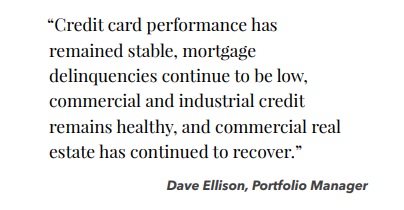
Overall, credit conditions remain favorable across both consumer and commercial lending. Credit card performance has remained stable, mortgage delinquencies continue to be low, commercial and industrial credit remains healthy, and commercial real estate has continued to recover. While private credit has experienced some deterioration, we have not seen those issues materially affect traditional consumer lending.
Although credit risk is always present, banks continue to maintain disciplined underwriting standards, a practice shaped in large part by the lessons learned during the 2008 financial crisis. As a result, we do not currently see evidence of broad-based deterioration in credit quality, and we believe the banking industry remains well positioned to navigate the current environment.
How is the AI infrastructure build-out influencing commercial and industrial loan demand?
Investment in AI infrastructure is contributing to increased commercial and industrial loan demand, particularly in regions benefiting from data center construction and related infrastructure projects. We also see strong lending activity in areas where manufacturing is expanding as companies continue to reshore production.
While both trends are supportive, we believe reshoring has the potential to be a broader and more durable driver of loan growth over the long term.
Where are you finding the most compelling opportunities across the Financials sector today?
Valuations appear attractive relative to the broader market. As of the end of June 2026, the Financials sector traded at roughly a 25% discount to the S&P 500 on a price-to-earnings (P/E) basis, while banks traded at an even lower multiple than the Financials sector overall. Large banks, as measured Hennessy Large Cap Financial Fund (HLFNX/HILFX) Hennessy Small Cap Financial Fund (HSFNX/HISFX) by the KBW Bank Index (BKX), traded near their historical average valuation, while regional banks, represented by the KBW Regional Banking Index (KRX), continued to trade at a modest discount to their historical average as of June 30, 2026. Based on P/E multiples, both groups traded approximately 40% below the S&P 500 at quarter-end.
From a portfolio perspective, we continue to favor both large and regional banks in the Hennessy Large Cap Financial Fund and small, well-run, traditional banks and thrifts in the Hennessy Small Cap Financial Fund. Large banks benefit from the scale and profitability needed to invest across their businesses, while regional and small banks with meaningful commercial and industrial lending exposure stand to benefit from favorable lending spreads and continued loan demand driven by domestic manufacturing and reshoring. We are more selective in areas such as insurance, where pricing pressures and exposure to private credit warrant additional caution.
Overall, we believe attractive valuations and favorable fundamentals continue to create compelling opportunities in large, regional, and small-cap banks.
- In this article:
- Financials
- Large Cap Financial Fund
- Small Cap Financial Fund
You might also like
-
 Fund Commentary
Large Cap Financial FundSmall Cap Financial FundSolid Industry Fundamentals & Continued Consolidation
David EllisonPortfolio Manager
Ryan C. Kelley, CFAChief Investment Officer and Portfolio ManagerRead the CommentaryPortfolio Managers Dave Ellison and Ryan Kelley review 2025 bank performance, fintech-driven consolidation, attractive valuations, and their constructive 2026 outlook.
-
 Fund Commentary
Large Cap Financial FundSmall Cap Financial FundSeeking Innovation in the Financials Industry
David EllisonPortfolio Manager
Ryan C. Kelley, CFAChief Investment Officer and Portfolio ManagerRead the CommentaryPortfolio Managers Dave Ellison and Ryan Kelley discuss what’s driving performance in the Hennessy Large Cap Financial Fund, how tariff increases affect banks, the interest rate environment, and the opportunities in financials.
-
 Viewpoint
Navigating the Financial Landscape in 2025
David EllisonPortfolio ManagerWatch the VideoHennessy Funds Portfolio Manager Dave Ellison discusses the key drivers behind the financial sector's strong performance in 2024, the impact of potential rate cuts and regulatory changes, and the evolving landscape of banking in 2025. He also explores the challenges and opportunities facing both large and small banks, the role of AI, and the critical risks to watch, from traditional credit concerns to transformative technological shifts.
