
Access Japan’s Structural Transformation via Japanese Small Caps
In the following commentary, the Portfolio Managers discuss opportunities in Japan’s small-cap market, highlighting attractive valuations, evolving tourism trends, and earnings growth.
-
 Takenari Okumura, CMAPortfolio Manager
-
 Tadahiro Fujimura, CFA, CMAPortfolio Manager
Key Takeaways
» During the third quarter, the market shifted to value, high-dividend and domestically oriented stocks.
» Careful stock selection remains important even though overall monetary conditions in Japan remain accommodative.
» Supported by the weaker yen and Japan’s growing appeal to tourists, inbound tourism has become diversified in nationality, destination and spending patterns.
» Select companies in Consumer Discretionary Distribution & Retail and Software & Services have had strong earnings growth supported by robust spending by affluent consumers, higher costs on pass-through pricing, and increased IT investment aimed at improving productivity.
» We believe small caps offer attractive valuations relative to large caps while providing access to the structural transformation of Japan.
Please summarize the Japanese small-cap market in the third quarter of 2026.
During the third quarter, market leadership shifted from artificial intelligence (AI) and semiconductorrelated stocks toward previously lagging areas, including value, high-dividend and domestically oriented stocks, resulting in varied performance across market indices. Within small caps, gains in information and communications stocks helped push the TSE Growth Index, a major emerging growthstock index, up by more than 10%, while the Fund’s benchmark performed broadly in line with Tokyo Stock Price Index (TOPIX). Year to date, Japanese equities have maintained solid performance, supported by resilient corporate earnings across both AI- and non-AI-related companies.
How could higher interest rates affect domestic small-cap companies?
While the 10-year Japanese government bond yield has risen above 3%, the policy rate remains below 2% and real interest rates remain negative. We therefore believe overall monetary conditions in Japan remain accommodative. Many Japanese companies have healthy balance sheets, which we believe should limit the potential impact of higher financing costs on earnings. Banks are among the sectors that could benefit from higher rates, although the impact varies depending on factors such as the duration profile of their bond portfolios and potential credit costs. We therefore believe careful stock selection remains important.
How is the changing mix of international tourists affecting Japanese companies?
Demand from Chinese group tourists, which historically played an important role in Japan’s inbound tourism, has declined sharply following the Chinese government’s calls since 2025 for its citizens to exercise caution when traveling to Japan. At the same time, supported by the weaker yen and Japan’s growing appeal as a tourist destination, inbound tourism has become increasingly diversified in terms of nationalities, destinations and spending patterns. As a result, we believe the beneficiaries have broadened beyond traditional areas such as department stores and duty-free retailers to include regional hotel and leisure facility operators.
A restaurant holding, Saizeriya, recently signaled potential price increases. Are you seeing similar opportunities for price increases among other portfolio companies without materially affecting demand?
Saizeriya Co., Ltd. is one of Japan’s best-known lowpriced restaurant brands, so its indication that it may raise prices attracted considerable attention among both market participants and consumers. However, the company has yet to formally announce price increases, making it too early to assess the potential impact on demand.
One portfolio example is United Arrows Ltd., which has maintained growth in average spending per customer at existing stores while customer traffic has remained resilient. We believe this reflects not only pricing but also improvements in product quality, higher full-price sell-through supported by better inventory management, and customer service. These initiatives are strengthening the brand and we believe should support further improvement in profitability over time.
Where do you see attractive opportunities among Japanese small-cap companies benefiting from AI?
We believe the human resources industry is one area with significant potential to benefit from AI. The industry is labor-intensive, and matching job seekers with employers represents a key source of monetization.
Historically, the quality and productivity of sales personnel and career advisors have been an important source of competitive advantage. Going forward, we believe the ability to use AI for candidate matching, applicant engagement, workflow automation and sales efficiency could create meaningful differences in profitability. One example is Recruit, which, although not a small-cap company, we view as a frontrunner in this area. We also see opportunities for other companies with the resources to invest in technology to gain market share.
Where are you seeing strong earnings trends among domestically oriented businesses?
We are seeing particularly strong earnings growth among selected companies in Consumer Discretionary Distribution & Retail and Software & Services. This has been supported by robust spending among affluent consumers, continued progress in passing higher costs on through pricing, and increased IT investment aimed at improving productivity.
What significant changes did you make to the portfolio during the third quarter?
The most significant portfolio change during the quarter was a new position in CyberAgent, Inc. The company is one of Japan’s leading internet companies and is developing its Media & Intellectual Property (IP) business as a growth driver alongside its gaming business. We believe the Media & IP business is transitioning from an upfront investment phase to an earnings growth phase, and see the potential for the company to increasingly serve as an “IP accelerator,” supporting a new phase of earnings growth. Meanwhile, near-term concerns, including uncertainty surrounding the gaming business, have weighed on the share price, creating what we believe is an attractive investment opportunity.
We also exited Kakaku.com, Inc. following the announcement of a tender offer, which reduced further share-price upside, and Nissan Chemical Corporation after its share price rose on expectations for growth in its semiconductor materials business. Against a backdrop of rising interest rates and geopolitical uncertainty, we believe companies capable of generating growth through their own initiatives are becoming increasingly attractive.
What catalysts could lead investors to take greater interest in Japanese small-cap companies?
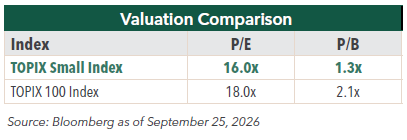
While the small-cap market is generally more niche than the large-cap market, we believe its relative attractiveness is increasing as global investor interest in Japanese equities remains elevated. In particular, we believe small caps currently offer attractive valuations on both price-to-earnings (P/E) and price-to-book (P/B) measures relative to large caps, while providing access to the structural transformation of Japan’s economy and corporate sector. The small-cap universe also remains broad and diverse, creating opportunities for bottom-up stock selection.
Corporate reform in Japan has so far been driven largely by external pressure for greater shareholder returns and reductions in excess capital, but we believe the next stage will increasingly involve management-led transformation through business portfolio restructuring. We have long focused on changes in management attitudes toward capital efficiency and broader efforts to transform their businesses. As global investor interest shifts from activism itself toward fundamental business reform, we believe interest in Japanese small caps could broaden.
To what extent does the Fund’s focus on domestic companies provide some insulation from global trade volatility and currency risk?
Approximately 50% of the portfolio is currently invested in domestically oriented companies, 25% in export-oriented companies, and 25% in companies with a mix of domestic and overseas exposure. The domestic allocation is relatively high compared with historical levels, reflecting both new investments in domestically oriented companies and share-price corrections in some semiconductor holdings after we took partial profits.
Our domestically oriented holdings span industries including construction, retail and services. Companies with strong pricing power may be able to pass on higher costs resulting from yen depreciation to customers, helping mitigate currency risk. These businesses are also inherently less exposed to global trade risks. Among our export-oriented holdings, many are semiconductor equipment and materials companies with leading market shares and products that are difficult to substitute. We therefore believe these companies may be relatively resilient to certain macroeconomic risks.
Would you please discuss current valuations of Japanese small-cap equities?
On both P/E and P/B measures, the valuation discounts of Japanese small-cap equities relative to large-cap equities are currently wide compared with their historical ranges. The P/B discount in particular has widened during 2026, even as returns-oncapital among small-cap companies have continued to improve. We therefore believe the relative attractiveness of the small-cap universe has increased.
What are opportunities and risks for domestically oriented Japanese companies as we end 2026?
One of the most important opportunities, in our view, is improving profitability in the service sector through greater pricing power and productivity gains. While product prices have risen amid yen depreciation and higher commodity prices, service-sector pricing has yet to fully move beyond Japan’s long-standing deflationary environment.
At the same time, demand remains strong in areas such as aging infrastructure, outsourcing and software solutions to address labor shortages. We believe these trends are creating a more favorable environment for service companies to raise prices and improve profitability.
A key risk is that inflation driven by higher oil prices and further yen depreciation could outpace wage growth. While inflation in Japan remains relatively contained compared with many other countries, Japan’s relatively low level of self-sufficiency in energy and other key resources leaves domestically oriented businesses exposed to rising import costs.
- In this article:
- Japan
- Japan Small Cap Fund
You might also like
-
 Investment Idea
Compelling Valuations in Japan
 Masakazu Takeda, CFA, CMAPortfolio Manager
 Angus Lee, CFAPortfolio Manager
Tadahiro Fujimura, CFA, CMAPortfolio Manager
Takenari Okumura, CMAPortfolio ManagerRead the Investment Idea
Japanese equities are currently trading at compelling valuation levels compared to other developed equity markets around the world and relative to their own historical averages. We believe the Japanese market deserves a closer look.
-
 Investment Idea
Why Active Matters When Investing in Japan
Masakazu Takeda, CFA, CMAPortfolio Manager
Angus Lee, CFAPortfolio Manager
Tadahiro Fujimura, CFA, CMAPortfolio Manager
Takenari Okumura, CMAPortfolio ManagerRead the Investment IdeaWhen investing in Japanese businesses, we believe it is imperative to select a manager who is immersed in the culture and can perform in-depth, company specific research to build a concentrated portfolio of Japanese companies that can outperform a benchmark and weather volatility.
-
Fund Commentary
Japan FundA Renewed Focus on Earnings Growth, Shareholder Returns & Valuations
Masakazu Takeda, CFA, CMAPortfolio Manager
Angus Lee, CFAPortfolio ManagerRead the CommentaryThe Tokyo Stock Price Index has risen 25% year-to-date through September and interest rates hit their highest in about 30 years. In this environment, the Portfolio Managers discuss their focus on growth potential and sufficient margin of safety to find companies with different return drivers across different macroeconomic environments.
