Where Opportunities Are Emerging in Equity and Fixed Income
In the following commentary, the Portfolio Managers discuss portfolio changes and where they are finding opportunity in the equity and fixed income markets.
-
 Stephen M. Goddard, CFAPortfolio Manager
 -
 Samuel D. Hutchings, CFAPortfolio Manager
 -
 Gary B. Cloud, CFAPortfolio Manager
 -
 Peter G. Greig, CFAPortfolio Manager
Key Takeaways
EQUITY
» The opportunity set has become more attractive for investing in companies we believe can withstand periods of economic and market uncertainty.
» Our process remains bottom-up, and recent volatility has mainly given us opportunities to add to high-quality businesses at attractive valuations.
» As of the end of the quarter, the portfolio held higher-quality, more profitable businesses at a slight discount to the market.
FIXED INCOME
» For bond investors, income grew more attractive even as the path of policy became less certain and more two-sided in the first half of 2026.
» We looked to be opportunistic, using the spread widening in high-quality software names, driven by AI-driven sentiment, as an attractive entry point into traditionally tight credits.
» The single most important variable that influences the positioning is how durable the inflation spike proves to be, and how the Fed responds to it.
Equity Portfolio
Would you please summarize equity market performance during the first half of 2026?
After a rocky start, U.S. equities staged a sharp reversal in the second quarter, with the S&P 500® posting its strongest quarter since 2020 and finishing the first half up 10.2%. The rally was fueled by artificial intelligence (AI) infrastructure spending and an earnings season that beat expectations, overcoming early-quarter anxiety over the Middle East conflict.
The economic backdrop has remained more resilient than many investors anticipated entering the year. Earnings growth has broadened beyond a narrow group of companies, supported by healthy consumer spending, improving business activity, disciplined corporate cost structures, and ongoing investment in AI infrastructure. While consumers remain resilient overall, corporate commentary suggests lower-income households are becoming more cautious, particularly around discretionary spending.
Inflation also remains above the Federal Reserve’s target, with monetary policy staying restrictive. While it has moderated from its peak, progress has been gradual as wage growth and services inflation continue to keep prices elevated. As a result, inflation remains the Federal Reserve’s primary policy focus. Combined with cooling hiring and choppy hard data, this paints a picture of an economy in the later stages of the business cycle.
After several years of AI-driven market leadership, where are opportunities emerging for value-oriented investors?
The opportunity set has become more attractive for investing in companies we believe can withstand periods of economic and market uncertainty. Our investment process is centered on owning, what we believe are, high-quality companies with durable competitive advantages, strong returns on invested capital, healthy free cash flow, and conservative balance sheets. Earnings growth has widened well beyond the handful of large companies that led in prior years. That said, much of the market’s return is still being driven by a narrow set of speculative names. As capital has chased that rally, many high-quality companies have been left behind and trade at valuations we find attractive, giving us the opportunity to own, what we believe are, high-quality businesses at reasonable prices.
What were the Fund’s largest contributors and detractors during the first half of 2026?
The largest contributor year-to-date based on relative performance vs. the benchmark was Entegris, as it benefited from improving fab utilization and accelerating AI-driven semiconductor demand. The company continues to gain share as advanced node transitions increase materials intensity per wafer, while improving memory and logic markets support broader growth. With its investment cycle largely complete, margin expansion and improving free cash flow should drive the next phase of earnings growth. We remain attracted to Entegris’ strong competitive positioning and high barriers to entry.
Other top contributors included Texas Instruments and FedEx.
The largest detractor year-to-date based on relative performance vs. the benchmark was Martin Marietta. Shares were pressured by elevated expectations rather than any meaningful deterioration in fundamentals. Infrastructure and nonresidential demand remain supported by Infrastructure Investment and Jobs Act (IIJA) funding and data center construction, while recent acquisitions should enhance pricing, margins, and cash flow. We remain confident in Martin Marietta’s ability to compound earnings over the long term.
TE Connectivity and BlackRock were also among the leading detractors from relative performance year-to-date.
Would you please discuss an example of a 2026 portfolio addition and exit?
Our process remains bottom-up, and recent volatility has mainly given us opportunities to add, what we believe, are high-quality businesses at attractive valuations, funded by trimming positions that had appreciated or where our conviction had lowered.
In January, we initiated a position in Dominion Energy, which operates as a predominantly regulated utility with stable earnings, improving financial flexibility, and attractive long-term growth drivers. More than 90% of earnings are generated from regulated electric and gas utilities in Virginia, North Carolina, and South Carolina, providing predictable cash flows and low revenue cyclicality.
Since 2022, the company has sold non-core assets, reduced debt, and brought in a partner on its offshore wind project, strengthening the balance sheet and improving financial stability. Over the long term, Dominion should benefit from growing power demand as data centers and AI usage expand in Virginia. Its exclusive service areas and regulated business model provide steady income and support an attractive dividend.
Equitable triggered our soft stop-loss review, and with no insider buying to reinforce conviction, we sold the position. While Equitable continues to generate strong cash flow and return capital in a disciplined manner, the underlying core business has remained inconsistent. Earnings quality is uneven, flows are mixed, and ongoing pressure in the individual life and retirement segments raises concern. Although valuation appears attractive, our confidence in the ability to deliver consistent results and successfully execute a turnaround was lowered.
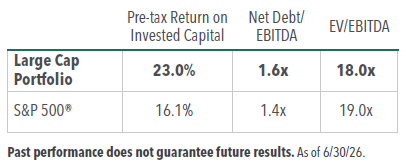
How does the portfolio’s return on invested capital, leverage, and valuation compare with the S&P 500?
As of the end of the quarter, the portfolio held higher-quality, more profitable businesses at a slight discount to the market. It is consistent with our discipline of owning durable, high return companies at reasonable prices.
What market themes are likely to have the greatest influence on portfolio positioning and investment opportunities?
Looking ahead, the current environment is unlikely to persist indefinitely. The themes we’re watching most closely are a reversion in the high-beta trade, a broadening of the market as fundamentals begin to matter again, and the expectation of more muted returns following the strong run of recent years. With valuations in the market’s leaders now stretched, we believe returns will increasingly have to be earned through fundamentals rather than further multiple expansion. High-quality companies with sustainable cash flows and shareholder-friendly capital returns should do well as this dynamic unfolds.
In that environment, our positioning is consistent: high-quality companies at a reasonable price. Quality has historically held up well in flat-to-down markets, so we believe the durable businesses we own are well positioned as this shift plays out. Meanwhile, with so much attention concentrated in a small group of momentum-driven names, a number of these companies have been overlooked and now trade at valuations we find compelling, which is where we see the best opportunities today.
Fixed Income Portfolio
How have changing expectations for Federal Reserve policy, inflation, interest rates, and unemployment influenced the fixed income market during the first half of 2026?
The first half of 2026 was defined by a decisive shift in the rate narrative, from “when will the Fed cut?” to “will the Fed hike?” The onset of the U.S.-Iran war and the resulting energy price shock reignited inflation, pushing headline CPI from a low of 2.4% to 4.2% in May and core Personal Consumption Expenditures from 3.0% to 3.4%. Critically, that inflationary pressure landed against a labor market that had firmed considerably from the concerning trend of 2025. After adding only ~116,000 jobs in all of 2025, nonfarm payroll growth more than quadrupled that pace in the first half of 2026, and the unemployment rate ticked down from 4.4% to 4.2%.
Against this backdrop, Kevin Warsh’s first meeting as Fed Chair struck a surprisingly hawkish tone. Forward guidance and the labor market side of the dual mandate were both stripped from the statement, leaving price stability as the sole emphasis. In the Summary of Economic Projections, the Committee raised its 2026 headline inflation outlook to 3.6% while lowering GDP growth to 2.2% and unemployment to 4.3%. Over the course of the first half, the market priced out the cuts it had expected entering the year and priced in a hike by the September or October meeting. The net effect was higher yields across the curve: the 2-year finished the half up 70 basis points (bps) and the 10-year up 30 bps. That bias toward higher short rates flattened the curve throughout the half. For bond investors, income grew more attractive even as the path of policy became less certain and more two-sided.
What notable changes were made to the fixed income portfolio so far in 2026?
Our changes have been measured and consistent with our neutral duration policy. We treated the backups in yields as an opportunity rather than a signal to reposition dramatically. We operate within a +/- 5% band around our duration policy. Because our portfolios naturally shorten as bonds roll toward maturity while the benchmark extends with new issuance each month, a static portfolio drifts short over time. As yields backed up, we used those moves to extend, typically from roughly neutral (0 to 1% long) out to 3.5 to 4.5% long, capturing higher yields and lower prices while staying well within policy. We concentrated most of those extensions in the belly of the curve rather than the long end, where we saw a better balance of yield and risk.
On the credit side, we remained constructive on high quality corporates, swapping into higher yielding issues that added incremental portfolio yield and, in select cases, adding new issuers that strengthened diversification and credit quality. We also looked to be opportunistic. For example, we used the spread widening in high quality software names, driven by AI-driven sentiment, as an attractive entry point into traditionally tight credits.
Given today’s yield curve and current credit spreads, where are you finding the most attractive risk-adjusted opportunities within fixed income?
With the curve relatively flat and short rates elevated on anticipated rate hikes, we see the best risk-adjusted value in the front end to the belly, roughly the 2-to-5-year area. Here, we believe, investors are well compensated without taking on the added volatility of the long end. More importantly, we think this part of the curve is priced for a hiking path we do not expect. Rate hikes are not our base case, since we believe the Fed is unlikely to tighten in response to an energy supply shock. With the effective overnight rate currently at 3.63%, we believe investors are being compensated well beyond the likely path of that rate. Should those hikes get priced out, front end yields would likely fall materially, outpacing any move in the long end. We acknowledge, however, the geopolitical situation driving this is highly fluid.
What are the Fund’s current duration profile and yield-to-worst as of June 30, 2026?
As of June 30, 2026, the portfolio’s effective duration was 3.78 and its yield to worst was 4.54% (30-day SEC yield for the investor class was 0.74%). That duration sits close to commonly used benchmarks and is consistent with our neutral duration policy. While a hike remains a live risk given the energy backdrop, it is not our expectation. A benchmark neutral duration lets us hold that view without overexposing the portfolio to a surprise in either direction. The elevated yield to worst also reflects the incremental spread we earn on our overweight to high quality corporate bonds. Should the growth outlook weaken materially, or long-term yields rise enough to improve entry points, we would revisit both duration and corporate weighting.
What macroeconomic developments are most likely to influence your positioning over the second half of 2026?
The single most important variable is how durable the inflation spike proves to be, and how the Warsh-led Fed responds to it. If the energy driven price pressure fades as the Committee expects, the case for stable or even lower rates strengthens. If inflation proves stickier, the risk of a hike, and of further upward pressure on yields, rises. The geopolitical backdrop in the Middle East is closely tied to this since any renewed disruption to oil supply would feed directly into inflation and policy expectations.
We are also watching the labor market. A rise in unemployment beyond the Fed’s 4.3% projection could shift the balance of risks back toward cuts, creating a tension that pulls the Fed toward both sides of its dual mandate. Given that uncertainty, we intend to stay close to neutral on duration and emphasize high quality income, letting attractive starting yields carry the return. We remain ready to extend duration or add credit if the data give us a clearer opportunity.
- In this article:
- Multi Asset
- Equity and Income Fund
You might also like
-
 Fund Commentary
Equity and Income FundA Focus on High-Quality Companies and Disciplined Positioning in Fixed Income
Stephen M. Goddard, CFAPortfolio Manager
Samuel D. Hutchings, CFAPortfolio Manager
Gary B. Cloud, CFAPortfolio Manager
Peter G. Greig, CFAPortfolio ManagerRead the CommentaryIn the following commentary, the Portfolio Managers discuss portfolio changes and where they are finding opportunity in the equity and fixed income markets.
-
 Fund Commentary
Equity and Income FundNavigating Volatility in Equities and Fixed Income
Stephen M. Goddard, CFAPortfolio Manager
Samuel D. Hutchings, CFAPortfolio Manager
Gary B. Cloud, CFAPortfolio Manager J. Brian Campbell, CFAPortfolio ManagerRead the Commentary
The Portfolio Managers of the Hennessy Equity and Income Fund discuss how they navigated the volatile markets during the first half of the year, outlining portfolio changes and areas where they are uncovering opportunities.
-
 Fund Commentary
Equity and Income FundAn Opportunistic Balance of High-Quality Stocks and Investment Grade Bonds
Stephen M. Goddard, CFAPortfolio Manager
Samuel D. Hutchings, CFAPortfolio Manager
Gary B. Cloud, CFAPortfolio Manager
Peter G. Greig, CFAPortfolio ManagerRead the CommentaryIn the following commentary, the Portfolio Managers of the actively managed Hennessy Equity and Income Fund provide their perspective on investing in high-quality companies and investment grade bonds in 2025.
