
Energy Resilience and a Changing Power Landscape
In the following commentary, Portfolio Managers Ben Cook and Josh Wein discuss energy sector performance, continued capital discipline, recent mergers and initial public offerings (IPOs) and valuations.
-
 Ben Cook, CFAPortfolio Manager
 -
 L. Joshua Wein, CAIAPortfolio Manager
Key Takeaways
» The energy sector posted strong year-to-date returns, supported by geopolitical disruption, higher commodity prices, and continued demand for energy security.
» Despite commodity price volatility, energy companies have largely maintained disciplined spending plans, prioritizing free cash flow, dividends, and share repurchases.
» Recent supply disruptions reinforced the importance of domestic production, reliable infrastructure, and strategic energy inventories.
» AI data centers, grid investment, and rising electricity demand have led to increased merger activity and new public offerings across the power sector.
» As of the end of June, the energy sector traded at a meaningful discount to the broader market while offering higher free cash flow yields than other S&P 500 sectors.
Would you please summarize the Energy sector’s performance through the first half of 2026?
In the first half of 2026, performance in the energy sector was broadly positive, driven predominantly by geopolitical disruption associated with the U.S. Iran conflict, which forced the effective closure of a key Middle Eastern supply chokepoint at the Strait of Hormuz. During the second quarter, U.S. and Iranian agreements to reopen the Strait triggered a pullback in crude oil pricing, which weighed on sector equity prices through the end of the period. Despite sector volatility, the energy sector posted a strong overall year-to-date total return of approximately 19.7%, outpacing the S&P 500 index return of 10.2%. Elevated energy commodity pricing, particularly retail fuel costs, fed into higher consumer prices with the consumer price index rising to 4.2% year over year by May, up from 2.4% year over in February. As a consequence, the Federal Reserve held interest rates constant late in the period, as the newly positioned Fed chair Kevin Warsh articulated a commitment to combatting price pressure in the U.S. economy.
How are energy companies positioning their businesses amid increased geopolitical uncertainty?
In the U.S. we have seen little change in energy company corporate behavior in response to the U.S. Iran conflict, as an abundance of in-country hydrocarbon production has ensured adequate volume to the U.S energy supply chain. During the conflict, however, energy companies, outside the U.S., responsible for sourcing volume from the Middle East, have had to reroute supply chains and rely more heavily on commercial and strategic reserve draws as dramatically reduced Middle Eastern volume necessitated alternative supply sourcing.
With reserves now vastly depleted, we expect that many of world’s energy importing countries will seek to expand strategic inventories of energy commodities to create a wider margin of safety in the event geopolitical disruptions arise. Importantly, the conflict has allowed the U.S. to demonstrate resiliency in the face of disruption, underscoring the strategic strength of the country’s self-reliance and partnership to energy export partners around the world.
How attractive does the energy sector look relative to the broader market?
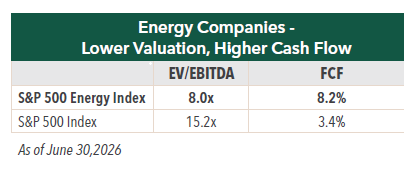
As of the end of June, the energy sector traded at a meaningful discount to the broader market while offering higher free cash flow yields than other S&P 500 sectors. With regard to valuation, the S&P 500® Energy Index is trading at 8.0x enterprise value (EV) to next 12-month EBITDA, versus the S&P 500® Index, which is currently trading at a multiple of 15.2x enterprise value to next 12-month EBITDA. Based on analyst consensus estimates, energy sector free cash flow yield, as tracked by the S&P 500 Energy Index, is higher than every other S&P 500 sector yet energy sector valuation is the lowest of any sector on an EV to forward EBITDA multiple basis. On a free cash yield basis, the S&P 500 Energy Index currently yields 8.2%, comparing favorably to the S&P 500 Index, which yields 3.4%, on that same basis.
With oil price volatility this year, how are companies balancing growth investments with their shareholder-return focus?
Despite the sharp uptick in commodity prices with the onset of the U.S. Iran conflict, few if any companies in our investable universe have altered their approach to prioritizing capital deployment. Alternatively, companies continue to demonstrate a deliberate approach to capital discipline, emphasizing shareholder-friendly capital allocation measures by prioritizing cash flow by limiting reinvestment rates in order to maximize cash return to shareholders through dividend payout and share repurchases.
What areas of the energy value chain appear most likely to see consolidation?
The U.S. upstream sector will continue to see consolidation as producers seek to build scale, lengthen inventory runways, and achieve acreage aggregation goals. We also expect to see significant corporate activity in the power sector where rising demand for power from artificial intelligence (AI) data centers is prompting power and utility company transactions to increase scale.
Several transactions underscore this trend. The recently announced Dominion Energy (D) and NextEra (NEE) merger will create the country’s largest power generation fleet, and Constellation Energy’s (CEG) acquisition of Calpine Corp. (private) will expand Constellations power generation asset footprint. We also expect to see continued consolidation amongst companies positioning to integrate natural gas assets to access lucrative liquefied natural gas (LNG) export markets given the expected growth in global gas usage going forward.
Would you please discuss what is driving the recent IPOs in the Energy sector?
Year-to-date, much of the IPO activity in the marketplace is taking place in the power sector where the growing demand for power generation and delivery is creating market opportunities for a number of companies.
Recent IPOs include, for example, Forgent Power Solutions (FPS) which is a U.S. designer and manufacturer of custom, engineered-to-order electrical distribution equipment. The company provides critical powertrain hardware for AI data centers, utility grids, and energy-intensive manufacturing. In addition, Solv Energy (SOLV), another recent IPO, delivers large-scale solar and battery storage projects. Another recent IPO, Fervo Energy (FRVO), has pioneered and proven a new approach to next-generation geothermal power generation, a 24/7 carbon-free energy resource.
Going forward, we expect to see additional capital formation and public offerings of companies that can offer differentiated solutions to contemporary market challenges, including power generation, transmission and distribution.
Would you please provide your outlook for the Energy sector?
We expect steady performance in the broader energy sector over the next 12 months, driven primarily by healthy energy commodity demand, the need for global inventory replenishment and the expansion in global natural gas usage.
While underlying energy demand trends should remain favorable, improving crude oil supply volumes will likely present headwinds to potential crude oil and refined product price gains. Alternatively, we see a growing market for natural gas supporting both improved pricing and supply growth. During the coming 12 months, we expect that energy commodity prices, across the hydrocarbon spectrum, will remain supportive of industry activity, allowing for continued favorable energy company capital allocation providing for modest growth and improving cash generation which should translate to favorable cash return to investors.
Finally, we see opportunities across the natural gas-oriented value chain in the U.S. as the growing market for natural gas will likely support both improved natural gas pricing and rising volumetric trends as producers increase activity levels to address market needs.
- In this article:
- Energy
- Energy Transition Fund
You might also like
-
 Investment Idea
Defining the Energy "Value Chain"
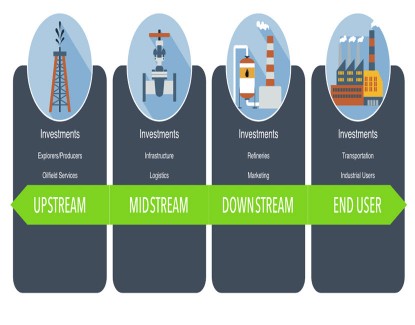
Ben Cook, CFAPortfolio ManagerRead the Investment IdeaEnergy is a large and complex sector. The sector’s broad sub-industries can be divided into a “value chain,” each segment of which has different characteristics and offers different investment opportunities.
-
 Fund Commentary
Gas Utility FundMeeting America’s Growing Energy Needs with Natural Gas
 Ryan C. Kelley, CFAChief Investment Officer and Portfolio Manager
L. Joshua Wein, CAIAPortfolio ManagerRead the Commentary
Ryan C. Kelley, CFAChief Investment Officer and Portfolio Manager
L. Joshua Wein, CAIAPortfolio ManagerRead the CommentaryThe Portfolio Managers discuss the drivers behind the Fund’s outperformance, the industry’s long-term growth outlook, and why utilities remain attractively valued.
-
 Fund Commentary
Midstream FundMidstream Companies’ Role in the Energy Buildout
Ben Cook, CFAPortfolio Manager
L. Joshua Wein, CAIAPortfolio ManagerRead the CommentaryPortfolio Managers Ben Cook and Josh Wein discuss the midstream sector’s strong first-half performance, rising natural gas infrastructure demand, the sector’s prudent capital allocation, and what we believe to be attractive valuations.
