
Midstream Companies’ Role in the Energy Buildout
Portfolio Managers Ben Cook and Josh Wein discuss the midstream sector’s strong first-half performance, rising natural gas infrastructure demand, the sector’s prudent capital allocation, and what we believe to be attractive valuations.
-
 Ben Cook, CFAPortfolio Manager
 -
 L. Joshua Wein, CAIAPortfolio Manager
Key Takeaways
» Underpinning the midstream sector’s strong returns were increasing natural gas infrastructure demand, LNG export expansion and rising power demand.
» Midstream sector growth tailwinds are being driven by booming natural gas demand associated with AI data center buildout and the continued growth in LNG export project development.
» Geopolitical supply shocks and corresponding volatility in energy markets have highlighted the importance of reliability and transparency in sourcing energy in the global market.
» Midstream companies are capitalizing on the rising demand for natural gas by pursuing a variety of growth projects to satisfy end-user needs.
» Combined with higher-quality balance sheets, consistent distribution growth, and higher distribution coverage ratios, we believe midstream companies offer a compelling entry point.
Would you please summarize the midstream sector’s performance through June 2026?
The Alerian U.S. Midstream Energy Index returned 24.1% in the first half of 2026, handily outperforming the S&P 500 return of 10.2%. The midstream sector’s strong returns were underpinned by increasing natural gas infrastructure demand, liquefied natural gas (LNG) export expansion and rising power demand associated with artificial intelligence (AI) data center growth. Sector investment merit continues to screen attractively for investors as company payouts and strong buyback activity combine to offer favorable shareholder cash return.
Would you please discuss the key factors driving investor sentiment toward midstream companies?
Investor sentiment continues to be very positive. Strong industry fundamentals, sound financial condition, and attractive shareholder cash return combine to make the sector an attractive choice for investors seeking high current income with the potential for inflation protection.
Midstream sector growth tailwinds are being driven by booming natural gas demand associated with AI data center buildout as well as the continued growth in LNG export project development. According to Wells Fargo Equity Research, natural gas demand is expected to rise on the order of 6.5% per year through the end of the decade on a compound annual growth rate (CAGR) basis, much higher than the 1.5% annual growth rate seen during the last 25 years.
The sector’s strong financial condition also continues to screen favorably with investors. Sector cash generation is largely based on stable, fee-based revenue which tends to shield midstream company balance sheets from energy sector commodity risks, while disciplined, self-funded capital spending programs allow for balance sheet strength.
Company cash returns, as mentioned, continue to be an attractive feature of the sector. In recent years, cash payouts have risen generously as midstream management teams, aligned with investors, have redirected strong financial results into shareholder hands with rising cash payouts and share repurchases.
How are midstream companies positioned to benefit from rising natural gas demand?
Midstream companies are capitalizing on the rising demand for natural gas by pursuing a variety of growth projects to satisfy end-user needs. First, demand for LNG exports continues to necessitate the buildout and integration of the LNG supply chain in the U.S., and second, demand for power generation capacity is prompting some U.S. midstream companies to participate in customized power generation projects. Midstream companies are developing unique project solutions to address evolving market needs as consumers at home and abroad increasingly look to natural gas to solve their energy supply dilemma.
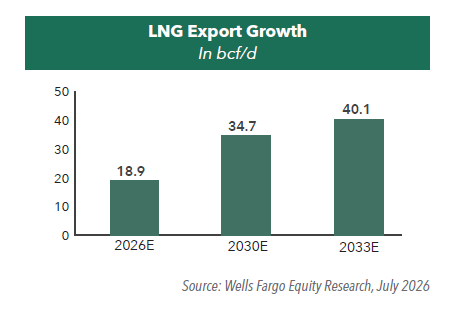
With regard to LNG exports, rising LNG export project backlog portends significant future output growth. According to Wells Fargo Equity Research, LNG export capacity based on projects currently under development will rise by 15.8 billion cubic feet per day (bcf/d) to a total of 34.7 bcf/d by year end 2030. When including projects likely to reach Final Investment Decision (FID), LNG export capacity will likely rise to 40.1 bcf/d by 2033, more than doubling the expected 2026 export capacity of 18.9 bcf/d.
Recent transactions signal a desire by midstream operators to consolidate key assets positioned near major LNG export hubs. For example, Williams Companies (WMB) is said to be in negotiations to acquire Momentum Midstream specifically to control a natural gas transportation capacity feeding the rapidly growing LNG export facilities along the U.S. gulf coast.
Regarding power generation project development, midstream companies are taking a solutions-oriented approach to addressing rising AI power consumption needs. Hyperscalers such as Amazon, Google, and Microsoft are speeding up power generation solutions by partnering with several midstream companies to build lateral pipelines, co-located natural gas turbines, and dedicated behind-the-meter generation facilities directly at data center sites. For instance, Williams is participating in nearly $10 billion in data-center-related projects. Additionally, Enbridge is actively pursuing over 50 specific data center energy projects to connect pipeline supply to power generation developments.
How have recent geopolitical developments changed U.S. energy infrastructure investment and export opportunities?
Geopolitical supply shocks and corresponding volatility in energy markets have highlighted the importance of reliability and transparency in sourcing energy in the global market. Accordingly, we see the U.S. midstream sector as a primary beneficiary going forward as U.S. energy export partners increasingly look to the U.S. as dependable source of hydrocarbon energy supply.
During the recent U.S. Iran conflict, a number of midstream companies played a key role in facilitating expanded export volumes of crude oil, natural gas liquids and LNG. We expect U.S. exports could remain elevated as importers work to rebuild commercial and strategic inventories. Rising throughput volume and ultimately volume export will highlight midstream sector importance as U.S. midstream companies play a vital role in helping trade partners restore depleted inventory balances.
How are midstream companies balancing the need to invest in new infrastructure with their commitment to capital discipline, dividend growth, and share repurchases?
Across our midstream investable universe, we continue to see midstream corporate management teams demonstrate prudent capital allocation, prioritizing balance sheet strength and shareholder cash return while taking a measured approach to capital spending.
Capital deployment decisions are now more aligned with investors than any time in the past. Capital spending decisions are rooted in rigorous project return scrutiny, and generally self-funded to minimize reliance on external funding sources. Surplus cash generation is often redirected to reduce balance sheet leverage first, followed by cash payouts in form of dividends, distributions and share repurchases. For investors, the prospect of balance sheet strength and cash return remain an attractive complement of investment merit, underscoring the attractiveness of the midstream sector in today’s marketplace.
What is the valuation of midstream master limited partnerships (MLPs) and C-Corps compared to historical averages?
We believe midstream companies look attractively priced. Master limited partnerships (MLPs) continue to trade at a discount to their long-term average. According to Wells Fargo Equity Research:
- As of the end of June 2026, the enterprise value (EV) to estimated 2027 EBITDA of the MLP sub-group was 8.8x relative to the 10-year average of 9.3x on the same basis.
- For midstream C-Corps, the group is currently trading around 10.7x, nearly inline to their 10-year average of 10.6x.
Combined with higher-quality balance sheets, consistent distribution growth, and higher distribution coverage ratios, we believe midstream companies offer a compelling entry point.
- In this article:
- Energy
- Midstream Fund
You might also like
-
 Investment Idea
Defining the Energy "Value Chain"
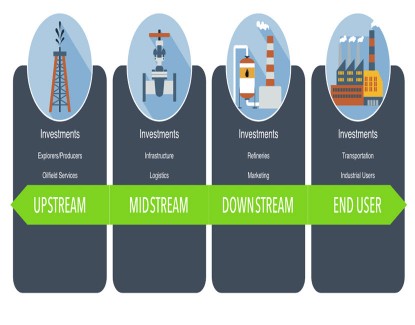
Ben Cook, CFAPortfolio ManagerRead the Investment IdeaEnergy is a large and complex sector. The sector’s broad sub-industries can be divided into a “value chain,” each segment of which has different characteristics and offers different investment opportunities.
-
 Fund Commentary
Gas Utility FundMeeting America’s Growing Energy Needs with Natural Gas
 Ryan C. Kelley, CFAChief Investment Officer and Portfolio Manager
L. Joshua Wein, CAIAPortfolio ManagerRead the Commentary
Ryan C. Kelley, CFAChief Investment Officer and Portfolio Manager
L. Joshua Wein, CAIAPortfolio ManagerRead the CommentaryThe Portfolio Managers discuss the drivers behind the Fund’s outperformance, the industry’s long-term growth outlook, and why utilities remain attractively valued.
-
 Fund Commentary
Energy Transition FundEnergy Resilience and a Changing Power Landscape
Ben Cook, CFAPortfolio Manager
L. Joshua Wein, CAIAPortfolio ManagerRead the CommentaryIn the following commentary, Portfolio Managers Ben Cook and Josh Wein discuss energy sector performance, continued capital discipline, recent mergers and initial public offerings (IPOs) and valuations.
