
Potential Natural Gas Tailwinds for Midstream Companies
The following commentary highlights how recent events in Venezuela affect midstream investors, how midstream companies could benefit from interest rate cuts, rising natural gas and LNG demand, and AI-driven efficiencies, while maintaining disciplined capital allocation, strong shareholder returns, and attractive valuations.
-
 Ben Cook, CFAPortfolio Manager
 -
 L. Joshua Wein, CAIAPortfolio Manager
Key Takeaways
» Given recent events, Venezuela could present a significant opportunity for energy companies positioned to benefit from what may become the next leading U.S.-focused energy investment region.
» In 2025, midstream subsector equities continued to outperform other energy subsectors as well as the broader market.
» U.S. natural gas consumption is expected to rise due to increased LNG exports, the onshoring of manufacturing, and higher power demand driven by AI.
» We expect midstream cash payouts will continue to rise over the next several years, and as a result, the sector will likely remain appealing to incomeoriented investors.
» Master limited partnerships continue to trade at a discount to their long-term average.
Would you please discuss how the latest developments in Venezuela affect midstream investors?
With the Trump administration’s removal of Venezuelan President Nicolas Maduro, the U.S. may have an opportunity to influence the development of the country’s natural resources.
For U.S. investors, the move to reopen Venezuela creates potential opportunity for sector growth even with legal, operating, and financial risks. In our view, near term challenges will require a patient approach to capitalize on emerging Venezuelan energy opportunity, but in the long run, Venezuela could be an extremely opportunistic area for those companies uniquely positioned to capitalize on what may become the next great region for U.S. energy investment.
How might midstream companies benefit from potential rate cuts?
In a declining interest rate environment, we would expect Midstream equities to enjoy several benefits, including the following:
1. Midstream equities generally have a higher relative yield compared to both yield-oriented equities and fixed income alternatives. Those higher yields would become more attractive as investors seek to maximize yield in a declining rate environment.
2. A lower rate environment would potentially lower borrowing costs for midstream companies needing to source debt funding. Lower rates would imply reduced interest expenses and improved profitability, all else equal.
3. Midstream companies generally have stable cash flow given their fee-based operating model which provides a defensive posture amidst potential commodity price volatility tied to weakening economic environment.
How could midstream companies operating natural gas transportation infrastructure benefit from increased natural gas and liquefied natural gas (LNG) consumption?
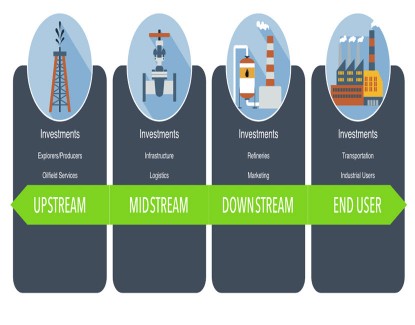
Midstream companies operate infrastructure that links the source of supply or wellhead to the end user consumer. Within this important value chain, midstream operators generate revenue by charging fees to gather, process, store, and transport volumes of natural gas.
Rising demand for natural gas as a fuel for power generation associated with artificial intelligence (AI), industrial onshoring, and LNG export increases the total volume flowing through existing assets, directly boosting revenue and profits.
As the world’s largest LNG exporter in 2025, the U.S. is expected to nearly double its export capacity by 2029, adding an estimated 13.9 billion cubic feet per day (Bcf/d) between 2025 and 2029. This creates a long-term “demand-pull” for midstream services.
How are midstream companies incorporating technological innovations such as artificial intelligence (AI) into their operations and processes?
As part of their daily operating activities, midstream companies generate and utilize a significant amount of data. AI is being used to optimize the data collection, analysis, and reporting process in a variety of ways to bring efficiency to a variety of midstream company activities.
For example, Williams Companies has partnered with Safety Radar which utilizes AI-driven strategies to uncover operating risk patterns, simplify compliance, and stay current with regulatory requirements. Kinder Morgan, Inc. has partnered with Palantir Co. to optimize data analysis and forecasting to predict natural gas demand for the Texas market, ultimately improving the company’s ability to meet demand.
By transforming data into actionable intelligence, AI enables midstream companies to shift from reactive to proactive management, fostering a smarter, safer more efficient energy sector.
Would you please discuss how midstream companies are balancing the capital needed to meet rising natural gas demand while maintaining disciplined spending and delivering strong shareholder returns?
Regardless of commodity orientation, proper alignment of corporate capital investment with shareholder interests is critical to midstream company governance. We believe that an optimal midstream company capital allocation program would incorporate a self-funded investment program as well as a systematic cash return to shareholders.
By minimizing external funding needs, midstream companies can reduce capital costs which in turn allows for greater cash generation. Cash allocation priorities are then applied in a shareholder friendly manner by first reducing debt and subsequently returning cash to shareholder return in the form of payouts and buybacks.
What is the current valuation of midstream MLPs compared to their historical average?
Master limited partnerships (MLPs) continue to trade at a discount to their long-term average. As of the end of 2025, the EV to estimated 2025 EBITDA of the MLP sub-group was 8.9x relative to its 10-year average of 9.7x. Likewise, midstream C-Corps are currently trading around 10.3x, slightly below their 10-year average of 11.0x.
Combined with higher-quality balance sheets, consistent distribution growth, and higher distribution coverage ratios, we believe midstream companies offer a compelling entry point.
What is your outlook for the Energy sector, specifically midstream companies in 2026?
We believe favorable energy sector fundamentals will continue to provide the opportunity for investor gains in 2026.
Strengthening demand for U.S. natural gas should provide a tailwind to natural gas market growth driving improved operating and financial results for many companies that operate natural gas oriented midstream assets. U.S. crude oil and liquids production growth will likely plateau during 2026, limiting growth opportunities for liquids oriented midstream companies.
Midstream sector investment merit continues to screen well, as stable, predictable cash generation, company valuation and natural gas market growth suggest relative outperformance in by natural gas oriented midstream equities.
- In this article:
- Energy
- Midstream Fund
You might also like
-
 Investment Idea
Defining the Energy "Value Chain"
Ben Cook, CFAPortfolio ManagerRead the Investment IdeaEnergy is a large and complex sector. The sector’s broad sub-industries can be divided into a “value chain,” each segment of which has different characteristics and offers different investment opportunities.
-
 Fund Commentary
Gas Utility FundMeeting America’s Growing Energy Needs with Natural Gas
 Ryan C. Kelley, CFAChief Investment Officer and Portfolio Manager
L. Joshua Wein, CAIAPortfolio ManagerRead the Commentary
Ryan C. Kelley, CFAChief Investment Officer and Portfolio Manager
L. Joshua Wein, CAIAPortfolio ManagerRead the CommentaryThe Portfolio Managers discuss the drivers behind the Fund’s outperformance, the industry’s long-term growth outlook, and why utilities remain attractively valued.
-
 Fund Commentary
Energy Transition FundEnergy Resilience and a Changing Power Landscape
Ben Cook, CFAPortfolio Manager
L. Joshua Wein, CAIAPortfolio ManagerRead the CommentaryIn the following commentary, Portfolio Managers Ben Cook and Josh Wein discuss energy sector performance, continued capital discipline, recent mergers and initial public offerings (IPOs) and valuations.
