
Strength of U.S. Natural Gas Reinforced by Global Energy Turmoil
The Hennessy Gas Utility Fund portfolio managers joined a record-setting crowd at this year’s AGA Financial Forum. With the heightened geopolitical uncertainty amplifying the strengths of the U.S. natural gas industry, the Forum provided an opportunity to better understand the evolving opportunities and challenges facing gas utility companies.
-
 Ryan C. Kelley, CFAChief Investment Officer and Portfolio Manager
 -
 L. Joshua Wein, CAIAPortfolio Manager
Key Takeaways
» Geopolitical tensions and volatility across global energy markets contributed to record attendance at this year’s AGA Financial Forum.
» The industry’s resilience is a “badge of honor” for the U.S. natural gas industry.
» With record levels of demand and ample supply, U.S. natural gas is reliable, affordable, abundant, and in our own political control.
» The Hennessy Gas Utility Fund is a convenient and simple way to access the group of publicly traded members of the American Gas Association.
Resilience—A “Badge of Honor”
Geopolitical tensions and volatility across global energy markets contributed to record attendance at this year’s AGA Financial Forum, as investors and industry leaders gathered to discuss the increasingly important role of U.S. natural gas. Discussions highlighted the reliability, affordability, and growing strategic value of the U.S. natural gas market.
Leaders described the industry’s resilience as a “badge of honor,” highlighting the role abundant domestic resources and infrastructure continue to play in delivering reliable and affordable energy.
Growing Demand
Natural gas demand is expanding across multiple fronts, including manufacturing investments, rising power sector needs, increasing liquefied natural gas (LNG) exports, and steady customer additions.
- After 15 years of nearly flat U.S. electricity consumption, demand has increased by 2.1% per year, on average, over the last five years.1
- U.S. industrial natural gas consumption is expected to climb to record highs through 2027.2
- Net exports of U.S. natural gas are forecasted to grow 18% and 10% in 2026 and 2027, respectively.3
- The gas utility industry, with 20,000 miles of new distribution lines added in 2024, serves one new customer every minute of every day.4
Strong Supply
Supply fundamentals also remain exceptionally strong, with U.S. natural gas production continuing to reach record levels. According to the EIA, marketed natural gas production in the lower 48 states averaged 117 billion cubic feet per day (Bcf/d) in the first quarter of 2026, a 4% increase compared with the same period in 2025. This increase reinforces the U.S.’ position as the world’s largest natural gas producer.
Beyond production, the U.S. natural gas storage system represents a major strategic advantage. Storage capacity has been critical in protecting customers from extreme market volatility while ensuring reliability during periods of peak demand. The importance of that infrastructure was demonstrated earlier this year during Winter Storm Fern, a widespread snow and ice storm that affed 44 states and drove sustained, record-level natural gas demand for 10 consecutive days.
A Distinct Affordability Advantage for Consumers
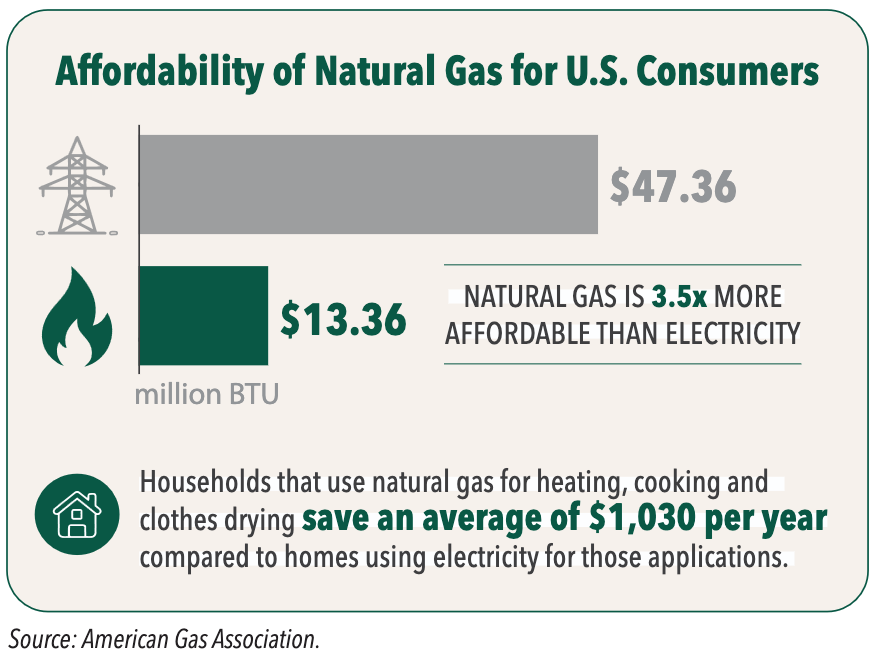
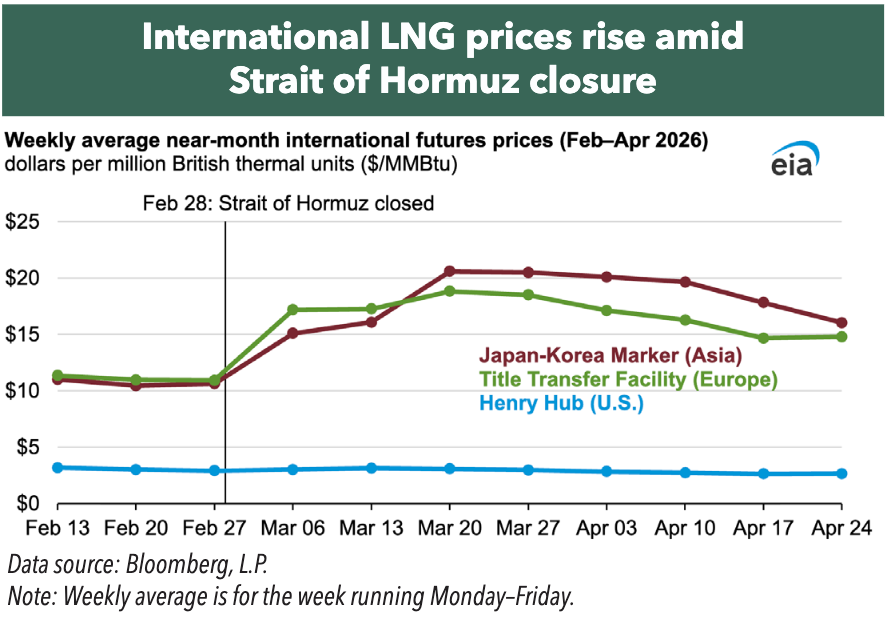
A robust long-term domestic resource base continues to provide U.S. consumers with a meaningful affordability advantage. Due to abundant shale reserves and sustained production growth, U.S. natural gas prices have remained significantly lower and less volatile than those seen in Europe and Asia, where markets are more heavily exposed to global LNG pricing and geopolitical disruptions.
Proven System Resilience
Industry leaders also emphasized the proven resilience of the U.S. natural gas system during periods of extreme weather and elevated demand. Winter Storm Fern served as a massive, long-duration test for the natural gas system. Rather than a single-day spike, the storm created sustained, record-level demand over a 10-day period across 44 states. At the storm’s peak, total daily gas demand reached 173 billion cubic feet, roughly four times the total energy generated by the entire U.S. electric grid in a single day.
Despite the prolonged strain, the natural gas system continued to operate reliably, supported by extensive pipeline infrastructure and underground storage capacity. Utilities were able to draw on stored gas supplies to maintain service and avoid far more expensive spot-market purchases, helping protect customers from severe price spikes.
The Critical Need for Improved and Additional Infrastructure
There is a critical need for additional pipeline and storage infrastructure as natural gas demand continues to grow across power generation, LNG exports, manufacturing, and industrial development. Expanding the nation’s natural gas network will be essential for maintaining system reliability and affordability.
In 2025, the industry spent approximately $50 billion on natural gas distribution construction and infrastructure projects. Going forward, achieving long-term infrastructure goals will require meaningful permitting reform to address policy and development bottlenecks that have slowed expansion efforts in recent years.
At the same time, utilities and regulators are navigating an increasingly complex operating environment, including severe weather events, physical and cybersecurity threats, supply chain disruptions, and labor shortages. In addition, rapid growth in electricity demand from AI data centers and broader industrial expansion has added pressure on utilities to modernize and strengthen the infrastructure.
The Opportunity in Natural Gas Companies
We believe the outlook for natural gas utilities remains constructive. Companies continue to forecast healthy levels of capital investment tied to infrastructure modernization, system expansion, and reliability initiatives. Expectations for earnings-per-share (EPS) growth generally remain in the 5%–8% range over the next several years.
Many companies also continue to offer attractive and growing dividends, reinforcing the sector’s appeal for income-oriented investors. As of June 10, 2026, in the Hennessy Gas Utility Fund, 45 out of 46 holdings pay a dividend with a median yield of 3.30%.5 Approximately 90% of holdings have increased their dividends over the past year.
Importantly, despite inflationary pressures, the overall regulatory environment remains supportive. Allowable returns-on-equity (ROE) generally remain consistent with historical levels, helping utilities maintain financial stability to fund long-term infrastructure investment while continuing to deliver reliable service to customers.
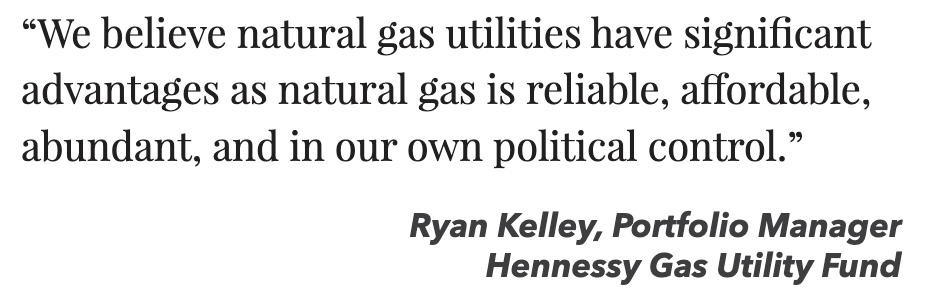
For investors seeking exposure to companies that could benefit from today’s positive natural gas dynamics, the Hennessy Gas Utility Fund is a convenient and simple way to access the group of publicly traded members of the American Gas Association (AGA).
- In this article:
- Energy
- Gas Utility Fund
1 EIA Annual Energy Outlook 2026.
2 EIA Today in Energy 5/15/26. 3EIA Today in Energy 4/16/26.
You might also like
-
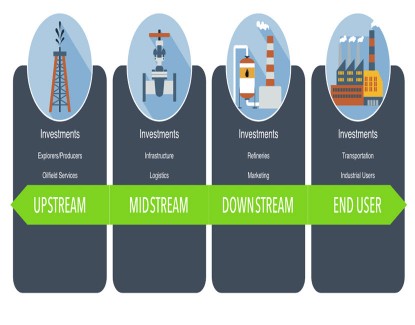 Investment Idea
Defining the Energy "Value Chain"
 Ben Cook, CFAPortfolio ManagerRead the Investment Idea
Energy is a large and complex sector. The sector’s broad sub-industries can be divided into a “value chain,” each segment of which has different characteristics and offers different investment opportunities.
-
 Fund Commentary
Gas Utility FundMeeting America’s Growing Energy Needs with Natural Gas
Ryan C. Kelley, CFAChief Investment Officer and Portfolio Manager
L. Joshua Wein, CAIAPortfolio ManagerRead the CommentaryThe Portfolio Managers discuss the drivers behind the Fund’s outperformance, the industry’s long-term growth outlook, and why utilities remain attractively valued.
-
 Fund Commentary
Energy Transition FundEnergy Resilience and a Changing Power Landscape
Ben Cook, CFAPortfolio Manager
L. Joshua Wein, CAIAPortfolio ManagerRead the CommentaryIn the following commentary, Portfolio Managers Ben Cook and Josh Wein discuss energy sector performance, continued capital discipline, recent mergers and initial public offerings (IPOs) and valuations.
